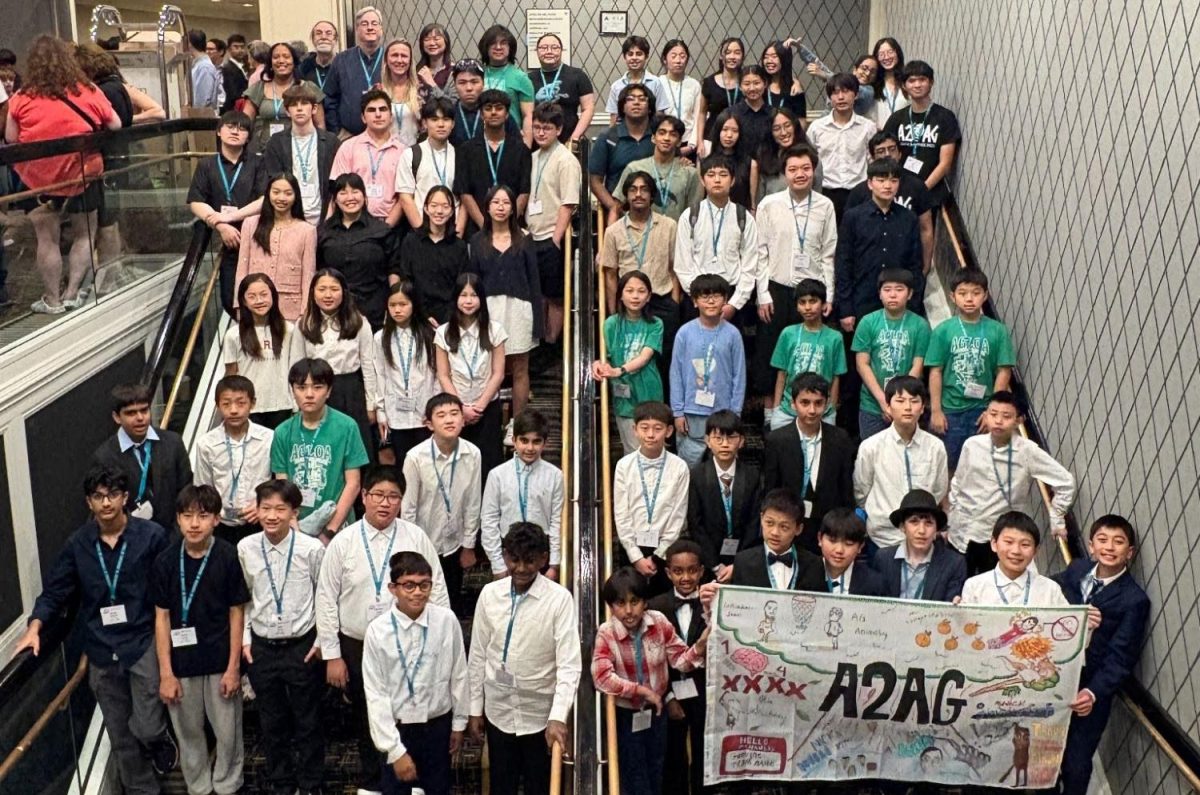
At the Academic Games (AG) 2026 National Tournament at Charlotte, North Carolina, Clague Middle School student’s hard work paid off. Students competed against players from around the country competing in games focused on math, language arts, and social studies.
“It was a great experience,” seventh grader Elaine Wu said. “I talked to a lot of new people, and I had fun with my friends.”
Practices took place from September through early March, with students meeting each week. The season ends with the three-day state tournament in early March and a six-day national tournament in spring for those who qualify. To get ready, students played mock rounds and worked together. These sessions helped students learn the games and get used to the pressure in the actual competition.
“The mock rounds made the actual tournament games feel way less intimidating,” eighth grader Priyam Chowdhury said.
Academic Games is divided into two main types of competition: the Cube Games and Reading Games. In Cube Games such as Equations, On-Sets, and LinguiSHTIK, students compete in small groups. Players have to think quickly while planning ahead.
“Equations is based on quick math skills and memorizing formulas while On-Sets is all about logic and critical thinking,” eighth grader Vihaan Sharma said.
Reading Games including Presidents, Propaganda, Theme, and Current Events. These games test the students’ knowledge as questions are read out loud. In Propaganda, players identify persuasive techniques used in media and everyday situations. In Presidents, students study U.S. history and presidents. They learn about their lives, decisions, and historical events that occurred during the presidencies. They apply that knowledge to rounds where they have to answer in the six point (hardest question), four point (fairly difficult), or two point (easiest) clues.
“Presidents was probably the hardest game for me,” sixth grader Sabrina Zheng said. “It’s challenging because there’s so many things to remember.”
The Academic Games National Tournament is held in a different city every spring. Students who qualify at States travel to compete for national titles as individuals and teams.
“The best part of the tournament was making new friends from other schools and connecting with my opponents,” Sharma said.
What makes Ann Arbor’s Academic Games different from other places is how everyone works together as a community. It starts from fourth graders just beginning their journey to high school seniors. Academic Games connects students across all grade levels, allowing them to build friendships along the way. Older students help coach younger players, sharing strategies, explaining the game, and building the foundation for their academic games journey.
“AG supports students from all grades levels by having different divisions that get progressively harder so everyone gets challenged,” eighth grader Siddharth Sivaramakrishnan said.
More than just a competition, Academic Games teaches students confidence, sportsmanship, and teamwork while building friendships. Whether solving equations, crafting sentences in LinguiSHTIK, or making quick decisions in rounds of Presidents and Propaganda, everyone is having fun.
“Participating in Academic Games has helped me grow as a teammate because I have improved my patience,” Zheng added.
In Ann Arbor, Academic Games isn’t just a club. It’s a community of students who build on each other year after year.