
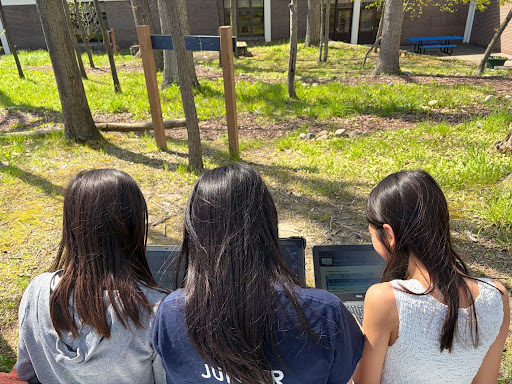
In AAPS, everyone is allowed a chance to be able to accelerate in math. In fifth grade, kids are allowed to move ahead in their grades for math by working ahead on other math grade levels. But they have to get into the program by having a high NWEA score and a good report card. Those who aren’t able to get in have the chance to participate in this program. They will be able to do it in sixth grade, or they can take a test that allows them to skip a grade. But what if you can move faster in grades for English, social studies, and science? AAPS offers summer programs that allow students to move faster in and ahead of their normal grade level.
“A2V+ summer term classes are asynchronous, meaning students access lessons, activities, and assignments on their own schedule,” AAPS said on its A2V website. “Work can be completed anytime and anywhere. A2V+ teachers are available for support, grading, and feedback.”
Students can take up to two classes (1.0 credit) through A2V during the summer through the Summer Program.
In the A2V summer term website, they stated that students may take up to 2 classes (1.0 credit). They recommended only one due to the workload but if a student plans to take two classes they must register and pay for both classes before the add/drop deadline. They have also stated that students must be on one track to complete the first half by the midway point to begin the second half.
Middle schoolers can take high school courses through the summer program. A2V math instructor, De’Marko Thurman, gives his opinion on this program.
“The class is still a four-month semester class; it just needs to be completed within five weeks instead of 18,” Thurman said. “As long as the student is willing to commit to this, I recommend it for them.”
To participate in the summer program and earn class credit, they need to pay. To take the A2V program in the summer, you have to pay $269 per class if you are an AAPS student, and $299 per class if you aren’t (to register for this class, click on this link). Sixth grader Adrienne Lin doesn’t recommend the summer program.
“It was very hard to understand the explanations, and I often have to reread them many times,” Lin said. “In person, I just ask my teacher for help, and she answers quicker than on the computer, and that took me a very long time to figure out.”
For many students, the summer program is very challenging due to the time commitment. But Thurman doesn’t agree with that.
“I believe that the summer program is a very beneficial opportunity for students to improve their grades or jump on fulfilling their graduation requirements if they are eligible to take it before the school year starts,” Thurman said. “It does, however, require that the student understands the time demand and commitment that they’re going to have to make to be successful.”
A2V requires students to finish by the last day of the Summer Term. There are no extensions as well, so students will have to finish their course(s) by the last day of the summer term.
“Because the term is short and moves quickly, students should plan carefully and begin on time,” according to the A2V website. “We do not recommend taking more than one class.”
Math teacher Meredith Pelchat recommends students reflect on the amount of work goes into an online course.
“Students should be willing to put in time for practice and coursework outside of class time,” Pelchat said. “Especially if they test out of a course or accelerate through A2V, they may have some gaps or items they have not fully learned. So it is important to constantly be reviewing all math topics — not just those you are currently learning.”
Pelchat states that students should not forget the math concepts that they have learned.
“High school credit courses have semester exams that cover the topics for a whole semester, so it is important not just to move on and forget the math concepts after a test,” Pelchat said.
Also, since the summer course is online, it may be harder to understand the math concepts and remember it long term because the topics are explained in text. Summer courses also do not have in-person math teachers to help you along the way, which can cause students to fall behind and not understand the topic as much as a student in an in-person math class.