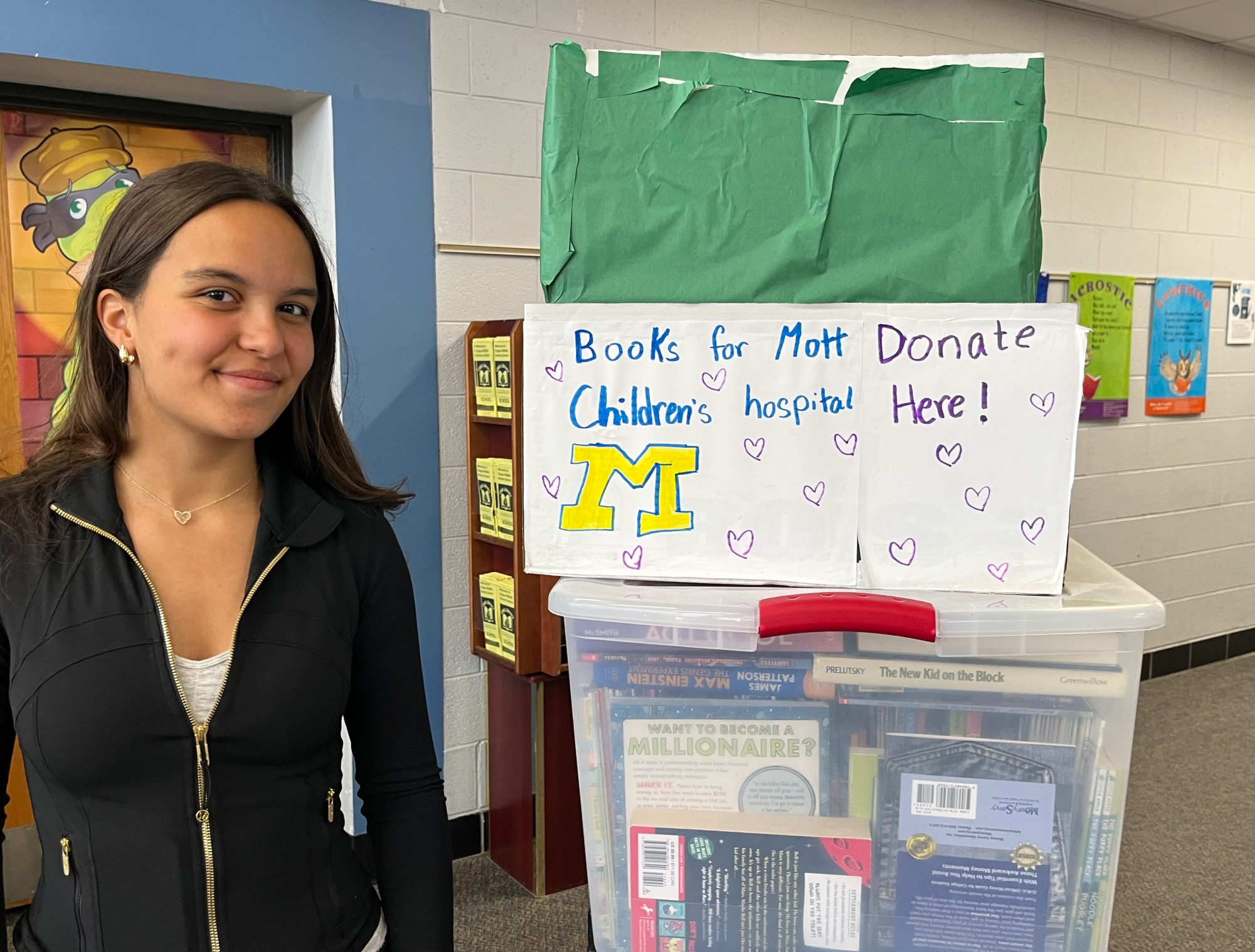

For eighth grader Anna Necula, the instinct to help didn’t arrive all at once; it built slowly, through years of curiosity about medicine and a growing desire to support kids her own age. She’d long been drawn to pediatrics, but as a middle schooler, most of the ways she hoped to get involved were out of reach. That limitation didn’t discourage her; it pushed her to look for something she could do. When she learned about the Giving Library at Mott Children’s Hospital, the idea clicked immediately. Necula spearheaded an initiative to provide children’s books to the giving library through a book drive. Here was a way to make a real contribution and to offer comfort to children who might need it most.
Necula brought the idea to her teachers, unsure of what would come of it, and was met with immediate support. Within days, boxes appeared in classrooms and hallways, each one soon to be filled with books. What began as a personal search for a way to help quickly became a shared effort, with students dropping in books between classes, daily morning announcements, and teachers spreading the word.
“I realized, oh, there isn’t much that I can do as an eighth grader, but then I realized something I could do is donate books to the library, because I noticed that they had a Giving Library on their resources for the patients,” Necula said.
The Giving Library is a small space inside Mott Children’s Hospital, but it means a lot to the kids who use it. Many of them spend long days in treatment, and having a book to read can make the time pass a little easier. When Necula learned about the program, it felt familiar to her. Reading had always been something she turned to when she needed a break or wanted to settle her mind, and she liked the idea that a book could give that same feeling to someone who didn’t have many choices about how they spent their day.
“Reading for me has been such a good tool; if you need a distraction from something, reading is a great way to do that,” Necula said. “I realized, kids in hospitals don’t always have lots of stuff to do, and it is so hard and scary to not have so much control, to have like an outing from that, or to have something to distract you from that, I think is probably a really good feeling.”
As the book drive picked up, Necula began to see how people around her were responding. Her teachers were quick to support the project, helping her organize donation boxes and spread the word. Her classmates were curious and encouraging, often stopping to ask about the drive or reacting with surprise that she had started it herself. The steady interest made the project feel less like something she was doing alone and more like something the school community wanted to be part of.
“Everyone has been pretty happy about it, like, interested in learning more about it,” she said. “My English teacher actually helped me out with it a lot.”
Even with the strong support around her, Necula learned quickly that running a schoolwide project came with its own challenges. The hardest part, she said, was getting the word out. At first, she assumed people would hear about the drive simply by seeing the boxes, but she soon realized she needed a clearer plan to make sure students actually knew it was happening. With help from teachers, she added announcements, slides, and posters, slowly figuring out how to reach more people.
“Advertising it was difficult, because at first I didn’t realize, like, how much you’d have to do,” Necula said. “I was just telling people, like, ‘Oh, you should get a book for my book drive,’ and they would say, ‘What book drive?’”
As the weeks went on, the results of the project became easier to see. The donation boxes that had started out empty began to fill, and the stack of books grew steadily. For Necula, it was a clear sign that people were paying attention and that the drive was working the way she hoped. What began as a small idea was turning into something concrete, supported by the people around her.
“I didn’t expect people to buy so many books,” Necula said. “I walked around and listed the books and the boxes of classes. Some only have five or so books, but others have full boxes. I was really happy to see it because I didn’t expect it.”
As the book drive comes to an end, Necula finds that helping people has made her feel connected to her community and gives her a purpose of sorts.
“It makes me feel like I’m contributing to something bigger than just myself,” Necula said. “I think it feels good to help other people.”
Against the odds, Necula has made a tangible difference in her community, and she now encourages others her age to do the same.
“If you have an idea you are passionate about, just do it, because there were a lot of things that I found hard and had some difficulties with,” Necula said. “But then, honestly, if you just reach out to anybody, they can help you with it. You just have to do the first step and ask.”